
Why Your Furnace Blows Cold Air: Troubleshooting Guide
Table of Contents
- Why Your Furnace Is Blowing Cold Air
- Check Your Thermostat Settings and Fan Mode
- Inspect Your Air Filter for Blockages
- Signs of a Bad Furnace Igniter
- Furnace Flame Sensor Cleaning and Maintenance
- When to Call an HVAC Technician
- Preventing Future Cold Air Problems
- Frequently Asked Questions
Last Updated: September 25, 2026
Why Your Furnace Is Blowing Cold Air
A furnace blowing cold air is one of the most frustrating problems homeowners face, especially when you're counting on heat during cold months. A furnace blowing cold air is one of the most frustrating problems homeowners face, especially when you're counting on heat during cold months. The good news: most causes are fixable without major expense. The good news: most causes are fixable without major expense.
Cold air from your furnace usually signals one of several issues. Your thermostat might be set wrong. Your air filter could be clogged. The ignition system might be failing. Or your blower is running when the furnace isn't actually heating. Understanding which problem you have is the first step to getting warm again.
This guide walks you through the most common causes and how to troubleshoot them yourself. We'll cover when you can fix it and when you need a professional HVAC technician.
Check Your Thermostat Settings and Fan Mode
Start here. This is where most people find their answer.
Your thermostat has a fan setting. It's usually labeled "Auto" or "On." If it's set to "On," your blower runs constantly, even when the furnace isn't heating. That's why you feel cold air.
Set it to "Auto" instead. The blower will only run when the furnace is actually producing heat. Cold air stops.
Also check your temperature setting. Make sure it's actually higher than the current room temperature. Sounds obvious, but it happens. If your thermostat is set to 65 degrees and your house is already 68, the furnace won't fire up.
Smart thermostats add another layer. Check that your Wi-Fi connection is stable. A disconnected smart thermostat can't communicate with your furnace properly. Reconnect it to your network and restart both devices.
Quick checklist:
- Fan mode set to "Auto"? (not "On")
- Temperature setting higher than current room temp?
- Smart thermostat connected to Wi-Fi?
- Battery level good on thermostat?
If you've checked all this and cold air persists, move to the next section.
Inspect Your Air Filter for Blockages
A dirty air filter is the second most common culprit.
Your furnace has an air filter that catches dust and debris. When it gets clogged, airflow drops. The furnace overheats and shuts down to protect itself. Your blower keeps running, but no heat is being produced. Result: cold air blows out.
Check your filter now. It's usually in a slot near your furnace or in a return air duct. Look at it. Is it dark gray or brown? Can you barely see light through it? That's your problem.
Replace it with a new one. This takes two minutes. Slide the old filter out, note the size printed on its frame, buy the same size, and slide the new one in. Arrow should point toward the furnace.
Most filters need replacing every three months. If you have pets or live in a dusty area, check monthly.
After replacing the filter, give your furnace 15 minutes to cool down, then turn it back on. You should feel warm air now.
What to look for:
- Filter color (dark = clogged)
- Filter size (printed on frame)
- Replacement frequency (every 3 months typical)
Signs of a Bad Furnace Igniter
If your filter is clean and your thermostat is set right, your ignition system might be failing. However, before assuming igniter failure, rule out a smart thermostat communication issue, which is increasingly common in modern homes.
Modern furnaces use two ignition types:
- Hot surface ignitors (HSI): A ceramic element heats to about 2,400°F to ignite gas. These are common in furnaces made after 1990.
- Pilot light systems: A small continuous flame ignites the main burner. Older furnaces and some newer models use this method.
When either fails, the furnace cannot establish a flame, so no heat is produced. The blower continues running on its cycle, pushing unheated air through your ducts.
A bad furnace igniter usually shows these signs:
- Furnace tries to start but clicks repeatedly without igniting
- You hear the gas valve open but no whoosh of flame
- Furnace cycles on and off every few seconds
- Blower runs but no heat comes out
- Furnace works fine for a few minutes, then shuts down
- You might smell gas briefly when the furnace tries to ignite
Before calling a technician, check for smart thermostat issues:
If you have a smart thermostat (Nest, Ecobee, Honeywell Home, etc.), a missing C-wire (common wire) can cause intermittent ignition failures. The thermostat loses power mid-cycle, interrupting the ignition signal. Look for a thin blue wire connected to your thermostat's C terminal. If it's missing or loose, this could be your problem, not the igniter itself. Reconnect it or contact your HVAC technician to install one. This is a $100-$300 fix, far cheaper than igniter replacement.
Also check if your smart thermostat recently updated its firmware. Software updates occasionally cause temporary communication delays with your furnace control board, resulting in failed ignition cycles. Restart both your thermostat and furnace (turn off the breaker for 30 seconds, then back on) to clear any sync issues.
If the igniter is actually failing:
A bad igniter needs professional replacement. An HVAC technician will test the igniter with a multimeter to confirm it's not generating the required voltage or heat, then install a new one. Replacement typically takes under an hour. Hot surface ignitor replacement costs $300-$500 on average; pilot light repairs vary depending on the component.
Don't ignore this. A furnace that can't ignite safely is a problem that gets worse. Get it fixed quickly.
Furnace Flame Sensor Cleaning and Maintenance
Your furnace has a flame sensor that detects whether the burner is actually lit.
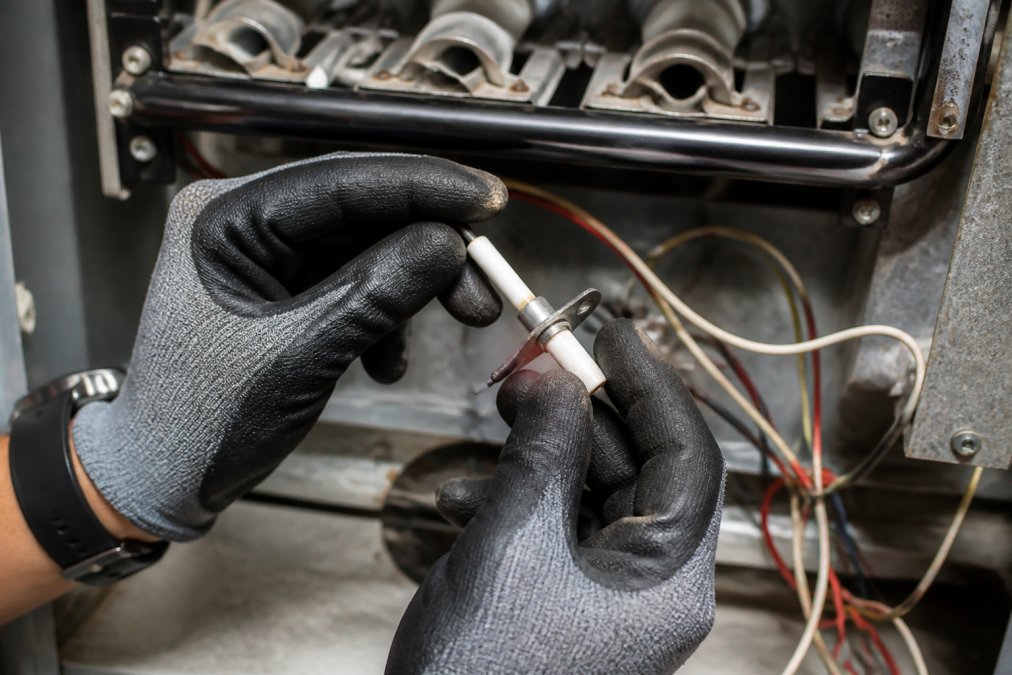
If the sensor gets dirty, it can't detect the flame even if one exists. The furnace thinks there's no flame, shuts down the gas, and cycles off. You get cold air from the blower but no actual heat.
How to clean a furnace flame sensor:
- Turn off power to the furnace at the breaker
- Locate the sensor (ask your furnace manual or search your model online)
- Gently remove it by unbolting the mounting bracket
- Use fine sandpaper or a soft wire brush to gently clean the rod
- Don't use harsh chemicals or steel wool, you'll damage it
- Reinstall it carefully and restore power
When to Call an HVAC Technician
You should call a professional if:
- Your igniter clicks repeatedly but won't light
- You smell gas when the furnace tries to start
- Cleaning the flame sensor didn't fix the problem
- Your furnace cycles on and off constantly
- You hear strange noises from the furnace
- Cold air continues after checking thermostat and filter
- You're uncomfortable working inside your furnace
Critical safety warning: Carbon monoxide risk
If your furnace is malfunctioning, especially if it's cycling repeatedly, won't ignite, or you smell gas, there is a potential carbon monoxide (CO) hazard. A furnace that fails to ignite properly can produce CO instead of burning gas completely. CO is colorless and odorless; exposure causes headaches, dizziness, nausea, and can be fatal at high concentrations.
What to expect from a professional diagnosis:
HVAC technicians use specialized equipment you don't have:
- Multimeters to test igniter voltage and flame sensor resistance
- Combustion analyzers to measure heat output and detect CO
- Pressure gauges to verify gas valve operation
- Thermal imaging to spot cracked heat exchangers
A full diagnostic typically takes 30-60 minutes.
Typical repair costs (for reference):
- Flame sensor cleaning: $100-$200 (often included in service call)
- Igniter replacement: $300-$500
- Gas valve replacement: $400-$700
- Control board replacement: $500-$1,200
- Heat exchanger replacement: $1,500-$3,000+
When DIY is safe; when it's not:
- Safe to DIY: Changing air filters, adjusting thermostat settings, cleaning flame sensors (if you're comfortable), checking C-wire connections on smart thermostats
- Not safe to DIY: Working with gas lines, testing ignition systems, opening the combustion chamber, handling control boards, or any repair involving the heat exchanger
Preventing Future Cold Air Problems
Keep your furnace healthy so this doesn't happen again.
Replace your air filter every three months. Mark it on your calendar. A clean filter keeps your furnace running smoothly and extends its life.
Frequently Asked Questions
Can a dirty air filter cause a furnace to blow cold air?
Yes. A clogged air filter restricts airflow through your HVAC system, causing the furnace to overheat and trigger the limit switch. This safety mechanism shuts down the burner and forces the blower to run on cold air only. Check your air filter monthly and replace it every 1-3 months depending on usage and pet hair. This is one of the easiest fixes for furnace blowing cold air and often solves the problem immediately.
Why is cold air coming out when heat is on?
Cold air during heating usually means your furnace is running but not producing heat. Common causes include a tripped limit switch (from overheating due to blocked airflow), a failed pilot light, a bad igniter, or a faulty flame sensor. Start by checking your thermostat settings, air filter, and pilot light. If those look normal, the furnace likely needs professional diagnosis, don't ignore this issue, as it may indicate a safety problem.
Should I turn my furnace off if it's blowing cold air?
If your furnace blows cold air for more than a few minutes after startup, turn it off and investigate. Check your air filter and thermostat fan setting first. However, don't leave it off during cold weather, you risk frozen pipes and system damage. If a quick restart and filter check don't restore heat, call an HVAC technician. Continuing to run a malfunctioning furnace can worsen internal damage and create safety hazards like carbon monoxide leaks.
How do I know if my furnace pilot light is out?
Look through the small window on your furnace to see if the pilot light flame is visible. It should be a small, steady blue flame. If you see no flame or a yellow/orange flame instead of blue, the pilot light is out or burning incorrectly. A yellow flame indicates incomplete combustion and requires professional attention. To relight it, follow your furnace manual's instructions carefully, if it won't stay lit or relights repeatedly, call an HVAC technician to check for gas supply or thermocouple issues.
When your furnace blows cold air, the cause is usually simple. Start with your thermostat and air filter, most problems stop there. If those checks don't solve it, your igniter or flame sensor likely needs attention. The Gentleman Plumber diagnoses furnace problems quickly and handles repairs with licensed, insured technicians. We provide transparent pricing and 24/7 emergency service. Request a call today to get your heat back.